Arya AirBlade Signature tweeters - can they transform your system ?

A slightly belated happy New Year to all you audiophiles out there. I'm sure that most, if not all, of you reading this forum are inspired to lift the performance of your proud system by using various means this coming year.
Recently, I've have been chumming up with my hi-fi buddy Marvel to attend lunch time concerts and last time we went to hear Midori play Mendelssohn violin concerto. I lamented to him that almost all the systems I have heard cannot faithfully or realistically reproduce the density of the orchestra (strings and horn instruments). I said this in the context of the sound image between the two speakers, especially the left and the right areas from the centre. Even with the speakers towed-in precisely, you can still hear/feel there are micro sound pockets, this has nothing to do with imaging but sound dispersion of the speaker units (mid-range and treble).
Let's get to the subject of AirBlade Signature tweeters, I have been a rather late user of Arya Audio Labs products, and not until 2024, I finally purchased their Orbius (phono-stabiliser and set-up tool), then Arya Tru. Level Platform with RevOpod footers for my turntable in mid-2025. Then in October, Arthur and Dominika visited Divin Lab to officially launch their power purifier device, Kyoon After the demo was over, I ordered two and later an additional one. Chris, at the event, also wasted no time to demo the AirBlade Signature tweeters. I was curious about whether they would raise the performance of my existing system, as many AE's customers have been using them. I plucked up the courage and ordered a pair as a birthday gift to pamper myself.
Two months later, the ABs finally arrived, but I was on holiday. As soon as I returned home, I intuitively placed the ABs with the same alignment next to my horn tweeters. The immediate impression was an improvement in transparency and a massive increase in details from the high, mid-high and mid-range. Another added pleasant surprise was an improvement in the bass, it has better attack with a cleaner tonal balance - most horn speakers with TAD bass units lacked transparent bass to my ears.
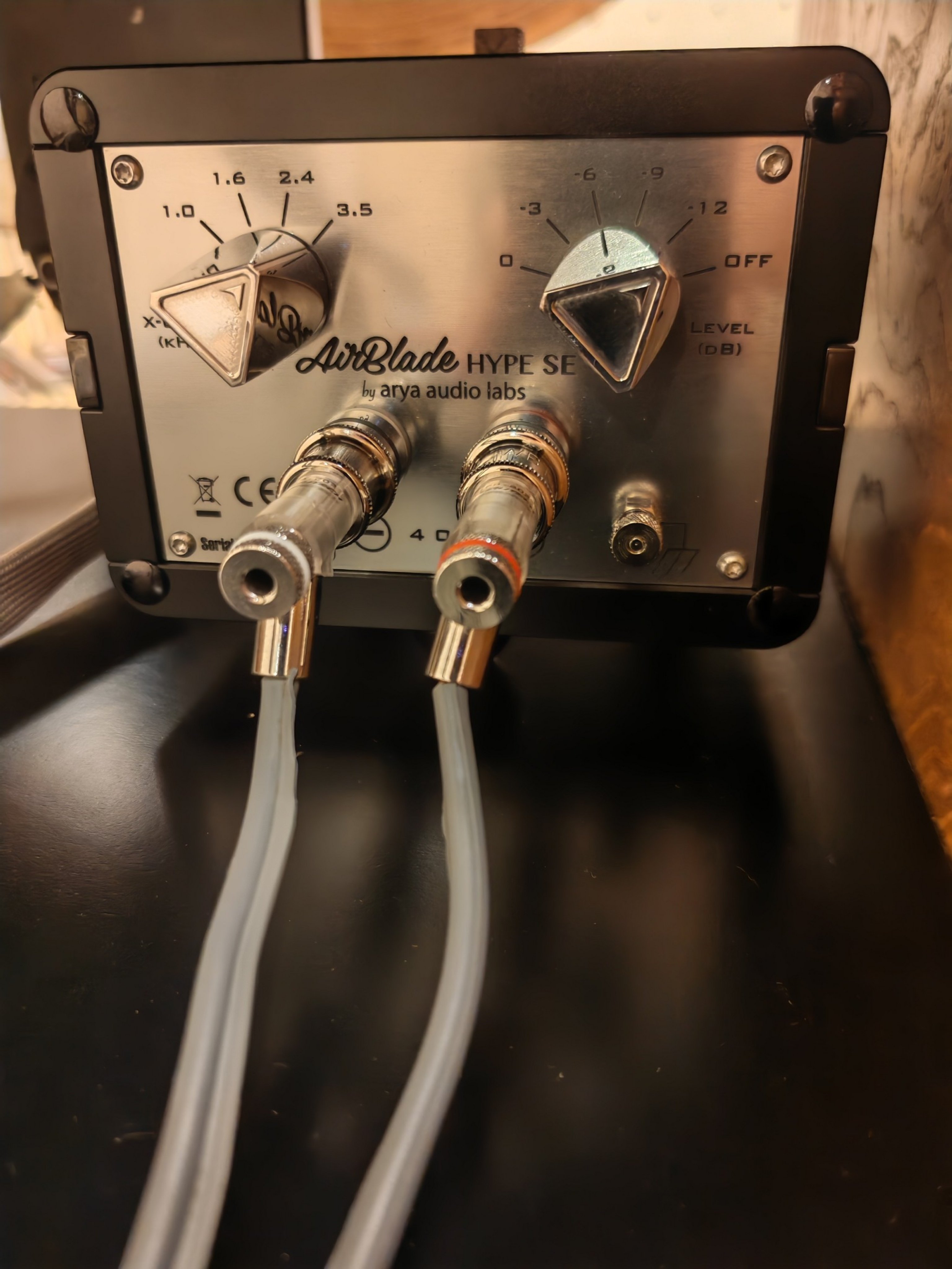
I deliberately used a pair of vintage (40 years plus) pure copper wires for a richer sound
However, after the initial listening thrill was over, I could feel a bit of listening fatigue. I quickly remembered Chris' recommendation of placing the ABs in opposite direction i.e. facing the wall behind the speakers. Right enough, the so-called brightness was reduced but the sound also turned less transparent (a bit dark) and imaging also deteriorated. By turning the ABs at 180 degrees to the speaker tweeter results in a 180-degree change in the acoustic phase, I rectified this by reversing one end of the speaker cable to the tweeter. The transparency had improved together with imaging, however, in the end, this reverse positioning was not to my liking.
Although I have been listening to my Cessaro horns for almost 18 years, before that, I had the pattern of changing loudspeakers almost every two to three years since 1973, this means I must have bought over 30 pairs of speakers during my audiophile career. All new speakers, I reckon, need at least 50-100 hours of break-in (horns need more) and this is the most painful process for me and this eventually led me to buying new speakers which were showroom products in order to skip this process plus getting a price discount !
After placing back the ABs to the original position, I moved them 1-2 mm at a time behind the horn tweeter and the brightness reduced incrementally. I reminded myself to have a proper listen after every 5 hours of break-in. On Dec 31, the 50-hour break-in period finally came, the brightness had gone. Because I had adjusted the room acoustics in the last 10 days, I needed to adjust them again using recordings of birds, bells, triangles, water and later violins in order to achieve the correct "pitch" based on my memory of the tonality of my system before the installation of ABs.
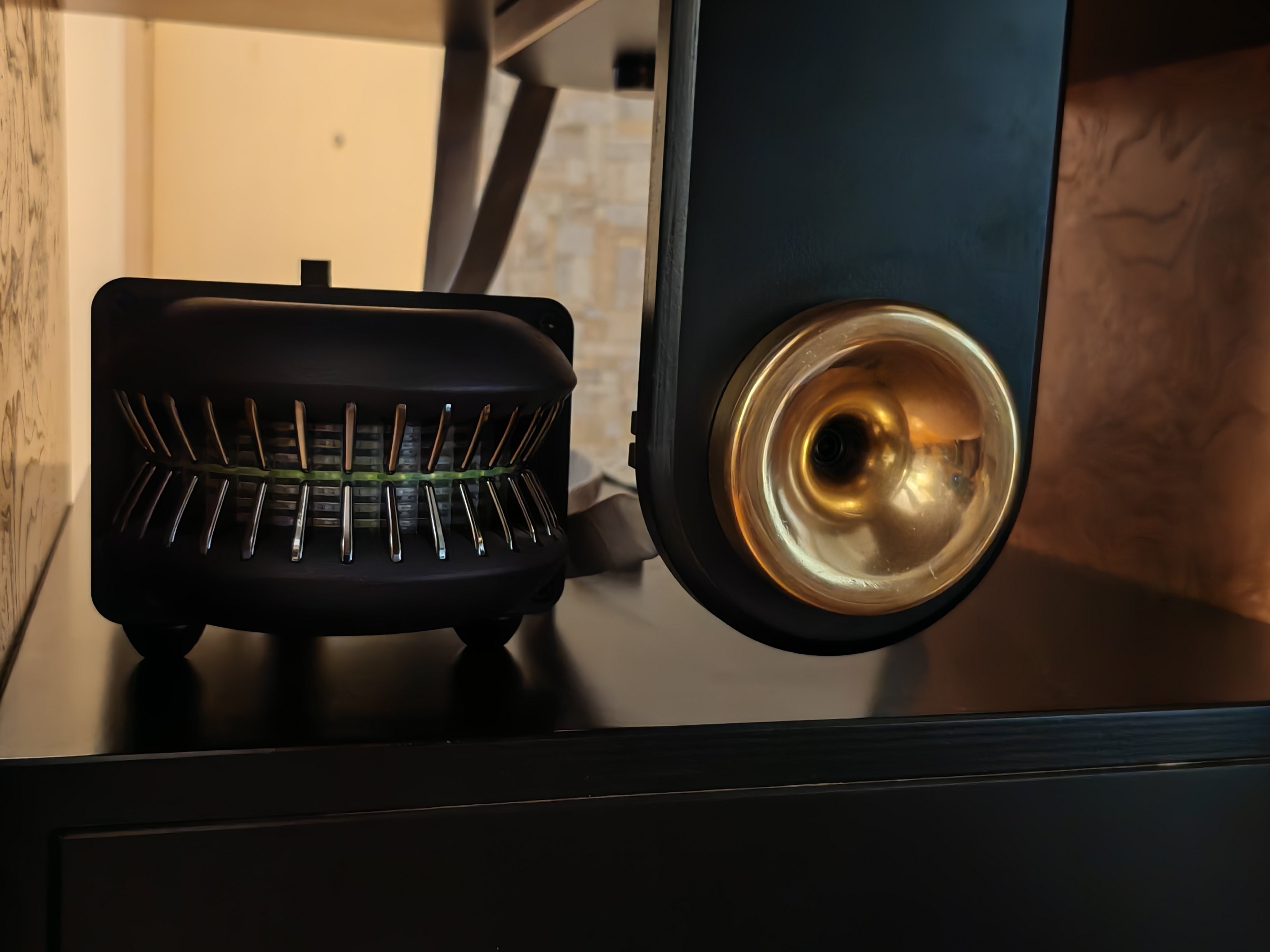
The AB sitting comfortably behind the TAD super tweeter
As mentioned above, I believe these tweeters will need around 100 hours of break-in before giving your system a natural sound. At present, I am thrilled every time I play my system especially when I listen to some familiar music for the first time with the ABs, I could hear more, details that were hitherto not noticeable in the past, are right there. It's definitely not brightness but new musical information which was hidden in the past now comes alive. Vocals are now the most obvious improvement, you can hear exactly how the singer sings. The soundstage, whether classical music, jazz or rock, now becomes more palpable, it has layers and depth but what strikes me the most is also an improvement in bass, the bass notes now hit the floor and bounce back. As a result, when you listen to a piece of music with the improvement mentioned above, you can almost see a musical picture/performance in front of you.
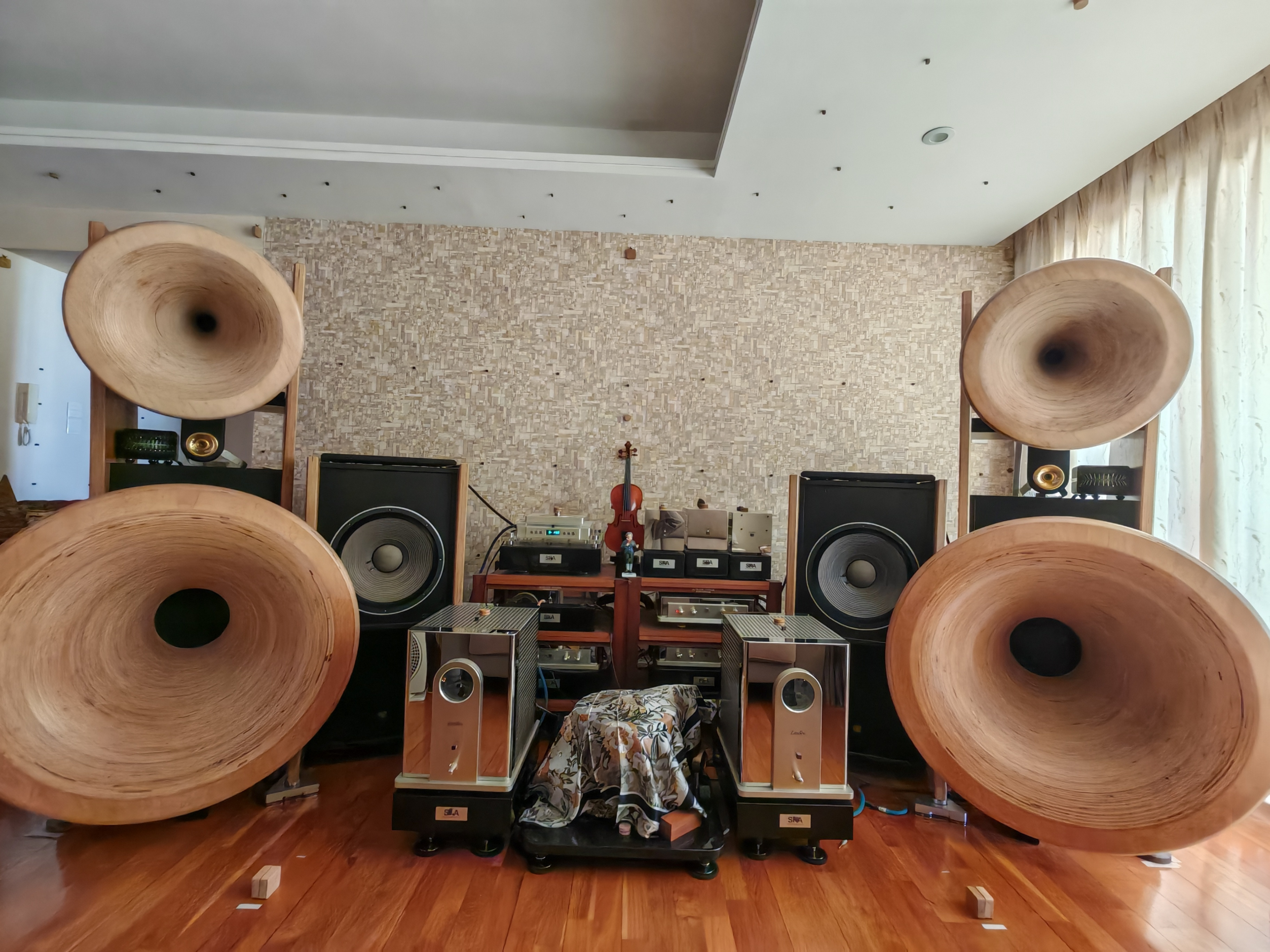
The sound between the two horns now with the ABs installed has greater density, orchestra, chamber music or Jazz and rock become more lifelike especially human vocals, I can continue…..
My preliminary conclusion is the AirBlade Signature tweeters literally lift the performance of my existing system by a few notches, it is like upgrading your speakers to a higher or top model. Notwithstanding the positive things I have stated, I must declare that integrating the ABs into your system is anything but a cinch. I reckon you'd need a pair of experienced and sensitive ears to be able to tune the system with the correct pitch as the ABs are more powerful in terms of its sound dispersion (manufacturer claims that a conventional tweeter's dispersion is about 30 degrees while ABs deliver 180 degrees of dispersion. My limited experience is that AB's must be aligned behind the speaker tweeter. Because my horn tweeter can move forward and backward, I had to also adjust the super tweeter backward too, it's like adjusting the vta and tracking weight of your cartridge in order to achieve the best tonality and balance.
Lastly, let's put the cost and benefits of AirBlades in perspective, the price is equivalent to a pair of modest loudspeakers, you may ask would one be better off by upgrading to another pair that is twice the price........... I don't know cos I haven't tried ! However, if the ABs are only 10-20% in terms of cost of your speakers, then I'm confident investing in them will give you the biggest bang for your buck. I'm so happy that I finally added ABs to my system, as I'm confident I'll continue keeping my horns for the next 10 years.
Happy 2026 and happy listening !
Mr Zanden
Comments
-
Epilogue
After playing/breaking in the AirBlades Signature for well over 100 hours using CDs as the source, I thought it was time to spin my vinyls to fully demonstrate the performance of my horn system.
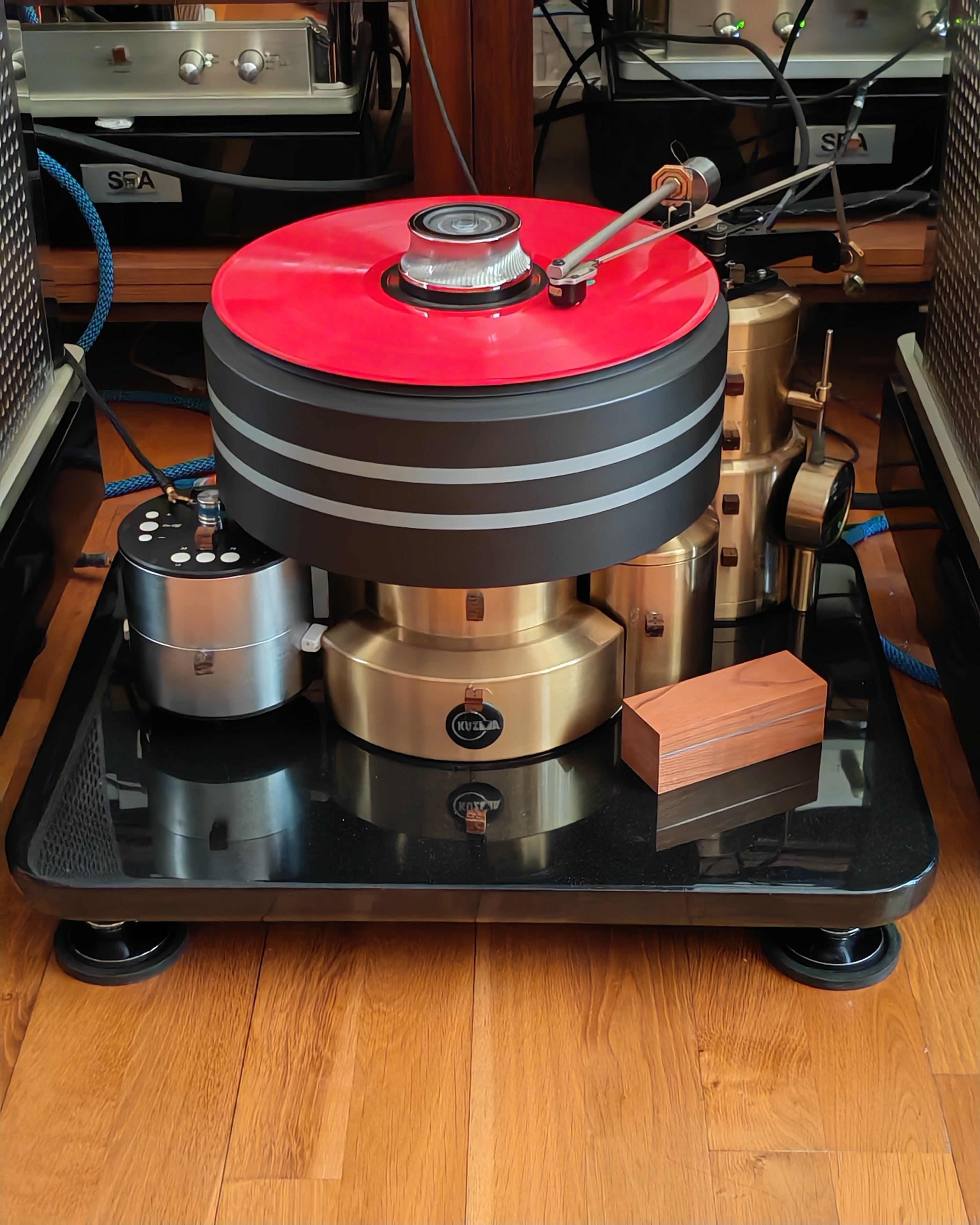
My turntable sitting on Arya Tru. Level Platform (there are 50 layers of graphite in it to absorb EMI) with RevOpod footers and Orbius, the Zanden footers help to absorb lateral vibration caused by walking footsteps
I must confess the changeover was met with an initial annoying hiccup. After playing a few of my familiar records, although there was an overall improvement in sound, the magnitude wasn't as great as I was expecting as compared to when I played CDs. I randomly picked Mutter's Schindler's List on John Williams' Themes and immediately detected the speed of the sound at the opening was slow (the pitch of her violin was dull), as if the turntable speed wasn't rotating slower than 33 1/3 rpm. To my bewilderment as well as disbelief, the laser reading was exactly 33.3, so what could possibly be wrong ? My hearing is perfect, as I can instantly recognise incorrect pitch and tonality (Marvel bro can attest to this). I naturally checked the tracking weight and VTA, but they were at the usual setting even though I hadn't played vinyls for over a month, as I used CDs to integrate the ABs to my system because a turntable is not a sole reliable source, in my experience, to tweak your hi-fi system.
Finally, after checking the cartridge mounting, the two screws were loose ! Something to share here, when I first owned the famous LP12 t/t in 1976, this turntable and speaker manufacturer recommended their cartridges should be tightened to "breaking or f_cking tight". Let's visualise 3 types of cartridge tightness, the first is where the cartridge is just securely mounted, but you can easily turn another notch to have it tightly attached to the headshell. The third setting is where you're using all your might to tighten the cartridge as if you may want to break it. Needless to say, the third mounting sounds the worst, the second lacks maximum harmonic decay and tuneful bass whilst the first setting gives the best overall sound, but the downside is you need to check and tighten the cartridge screws every so often, like after 7-10 days of continued playing or when the humidity is very low (wooden body cartridges will shrink a very tiny bit and then loosen the headshell mounting).
With the tightening of the cartridge to the abovementioned setting (1st type), I played Mutter again, and Bob's your uncle, the pitch of her violin was correct. I then spun the records that I listened to earlier and the overall sound improved. Therefore, the moral of this little story is to avoid tweaking your system with your turntable because there are so many variables in the vinyl playback chain that can go slightly wrong.
With my turntable setup now in tip-top shape, my horn system augmented with the AirBlades sounds immensely satisfying to my ears. Vinyls are able to dig out more details, dynamic bass, palpable mid-range and harmonic decay. Everything sounds more real, I'm still surprised by the bass improvement.
My latest impression as well as verdict of the ABs is that it literally lifts up the performance of your loudspeakers by a few notches, and as I had stated in the previous write-up, it's like upgrading your speakers to a higher model. However, these improvements vary for different users and my endorsements come with a caveat : unless you're able to integrate them into your system almost perfectly (this is a very controversial description), you may inadvertently alter the pitch, tonality, and imaging, as well as the transparency (I can go on) of your system, the most common negative effect to me is listening fatigue if they are placed too far forward beyond your speaker's tweeter.
I strongly advise users of the ABs to seek help from a competent, i.e., experienced/learned hi-fi dealer/buddy to integrate them into your treasured system, but for your own interest, you must quickly acquire this skill to do so, as fellow audiophiles are prone to always changing things in their system, especially if you upgrade your speakers in the future.
In closing, I'm thrilled to have added the AirBlades to my horn system, as the improvement they make is not unsubtle. Every time I play some favourite CDs or LPs that I have not listened to with the ABs before, I can easily hear more details and a better presentation of the performance. I am confident adding the ABs to your speaker system, regardless of the type and cost, would yield tremendous payback in sound improvement. Last night, after listening to my fully broken-in ABs, I did a reality check by attending a classical concert. Sure, the real event sounded better, but the strings on my systems are fairly real too. Today, I made some minute acoustic adjustments in the room using my memory of the instruments played at the concert in terms of pitch, tonality and harmonic decay. I shall be very busy rediscovering my LP collection in the next one to two months.
Happy listening,Mr Zanden ABs
1